
Check Logan Voter Registration
Utah's official voter status page offers two paths: start or update a registration, or look up an existing status. Choose “Look Up My Status” for the identity-match form. Enter the name exactly as it appears on the Logan registration, add the date of birth, and submit. A match can lead to current status and polling details. A mismatch calls for checking spelling and the date entered before treating it as evidence that no record exists.
| Lookup field | Input kind | Needed | How to enter it |
|---|---|---|---|
| First Name | Text | Yes | Use the registered given-name form |
| Last Name | Text | Yes | Use the registered surname |
| Date of Birth | Date input | Yes | Used to verify the voter's identity |
| SUBMIT | Button | Yes | Exact label shown by the form |
The lookup is for a voter checking that voter's own record. It is not a browse-by-surname directory for Logan residents. Private and withheld voters can still inspect their own data through this route. If the tool does not resolve a status question, Cache County Elections is the local fallback. Staff maintain Logan registrations and can explain whether an update or a county-level records request is the right next step.
The official entry screen shows where a Logan voter begins. View the Utah registration and status options before opening the identity form.
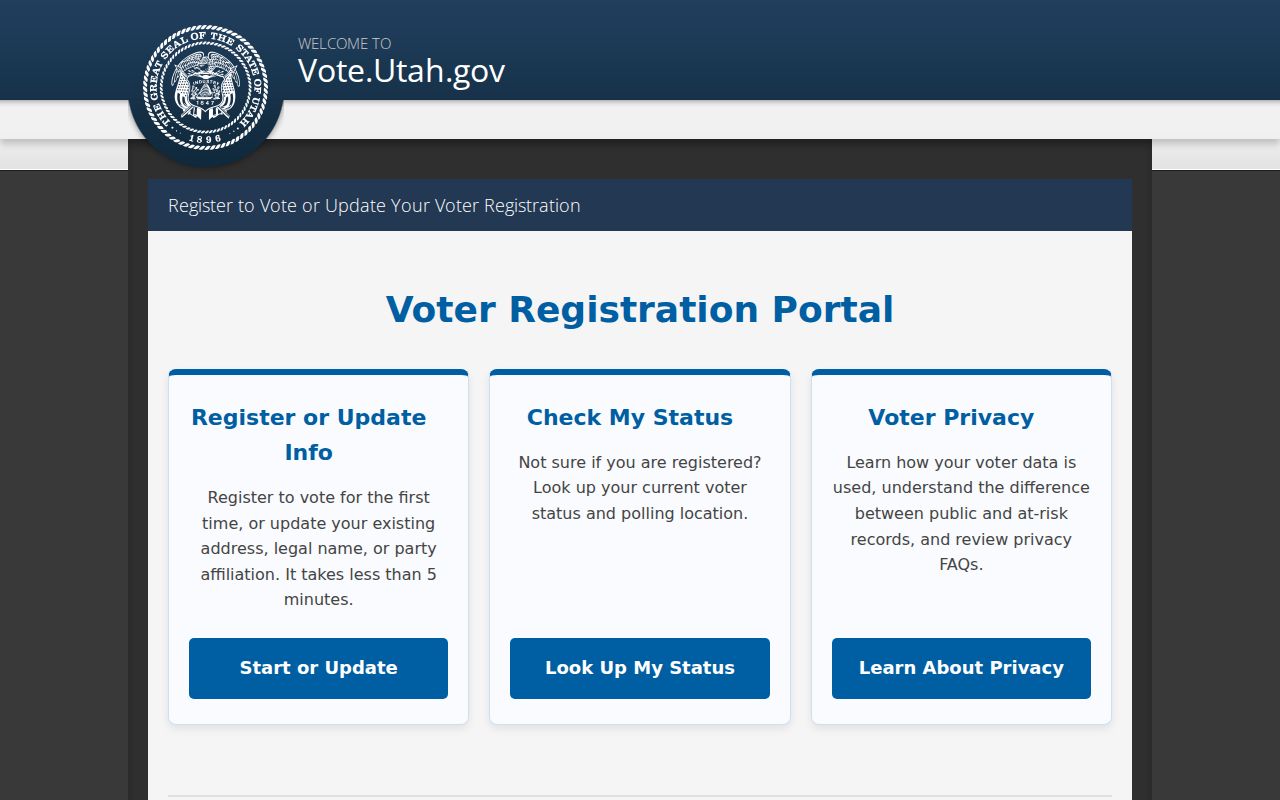
The split between registration updates and status checks helps keep a self-lookup from being mistaken for a public voter directory.
Logan Voter Lookup Myth
The phrase “voter lookup” can suggest an open search box where anyone types a Logan surname. Utah's tool does something narrower. It tests a set of identity details and returns the matched voter's own information. That design matters because the public voter database is a different product, obtained as a file rather than browsed through the personal status screen.
When a match appears, the interface may show party, precinct and district information, a ballot mailing address, the county or clerk contact, ballot status, and polling information as applicable. When no match appears, try the registered form of the name and review every field. A changed name, a typo, or a date mismatch may prevent the identity match. Contact Cache County Elections if the Logan record still cannot be confirmed.
Can someone use the tool to find every voter at an address? No. The status tool verifies one voter. Address-based list work belongs to the voter-file request process.
Note: The self-lookup's date of birth is an identity input, not a public field returned for other people to browse.
Logan Voter Record Fields
Utah Code §20A-2-602 defines the public portion of the statewide database that includes Logan voter records. Public data can identify the voter, locate the registration within Cache County, and show the districts linked to the residence. The field set also marks status and when the record was last updated. Public status does not mean that every piece of information supplied during registration is released.
| Identity | Full legal name, voter identification number, and age range |
|---|---|
| Addresses | Complete residence with unit details, plus mailing address and city, unless protected |
| Geography | County, precinct, and congressional, legislative, school-board, county-council, and city-council districts |
| Affiliation | Political party or unaffiliated designation |
| Record state | Active or inactive status and last update date |
| Participation | Election participation history, never selections made on a ballot |
Confidential under Utah law. Utah withholds Social Security numbers, driver-license or state-ID numbers, email addresses, full dates of birth, phone numbers, and signatures. Utah Code §§20A-2-601 through 20A-2-607 also provide stronger shielding for qualifying at-risk voters.
An age range may appear in the public file, but the full birth date used by the self-lookup remains protected. That difference is easy to miss when comparing a personal Logan status result with a purchased voter roll.
Protected Logan Voter Records
Utah's at-risk classification gives stronger anonymity to eligible voters. The state describes eligible groups that include victims or potential victims of domestic or dating violence, people under protective orders, law-enforcement officers, military members, public figures, and members of their households. The current statutory text controls when a summary and the law differ.
The at-risk voter category is separate from Utah's Address Confidentiality Program. That program provides a substitute-address and mail-forwarding system for qualifying survivors. A Logan participant should work through official program assistance so the substitute address is carried into the right state and local systems. Finding a protected address in another source is not permission to publish it.
Public NVRA reports also preserve that split. Public voters may appear with the name and address information required by the National Voter Registration Act. Personal data for private or withheld voters is redacted except for the county. A Cache County label therefore does not expose a protected Logan residence.
Cache Voter Lists for Logan
Cache County Elections processes voter rolls and maintains the local records that cover Logan. The office is at 179 N Main Street, Suite 102, Logan, UT 84321, and the published phone number is 435-755-1460. Use the county route for a Cache County or district subset because the Lieutenant Governor does not sell those smaller extracts.
Start with the Cache County Elections office page, which shows the local contact route for Logan voter records, then ask for the geographic scope and type of data needed. Confirm office hours before a visit. The hours shown on a different Clerk counter cannot be assumed to govern elections services. For general access-law questions outside the Election Code, the broader request framework is covered under Logan public records access.
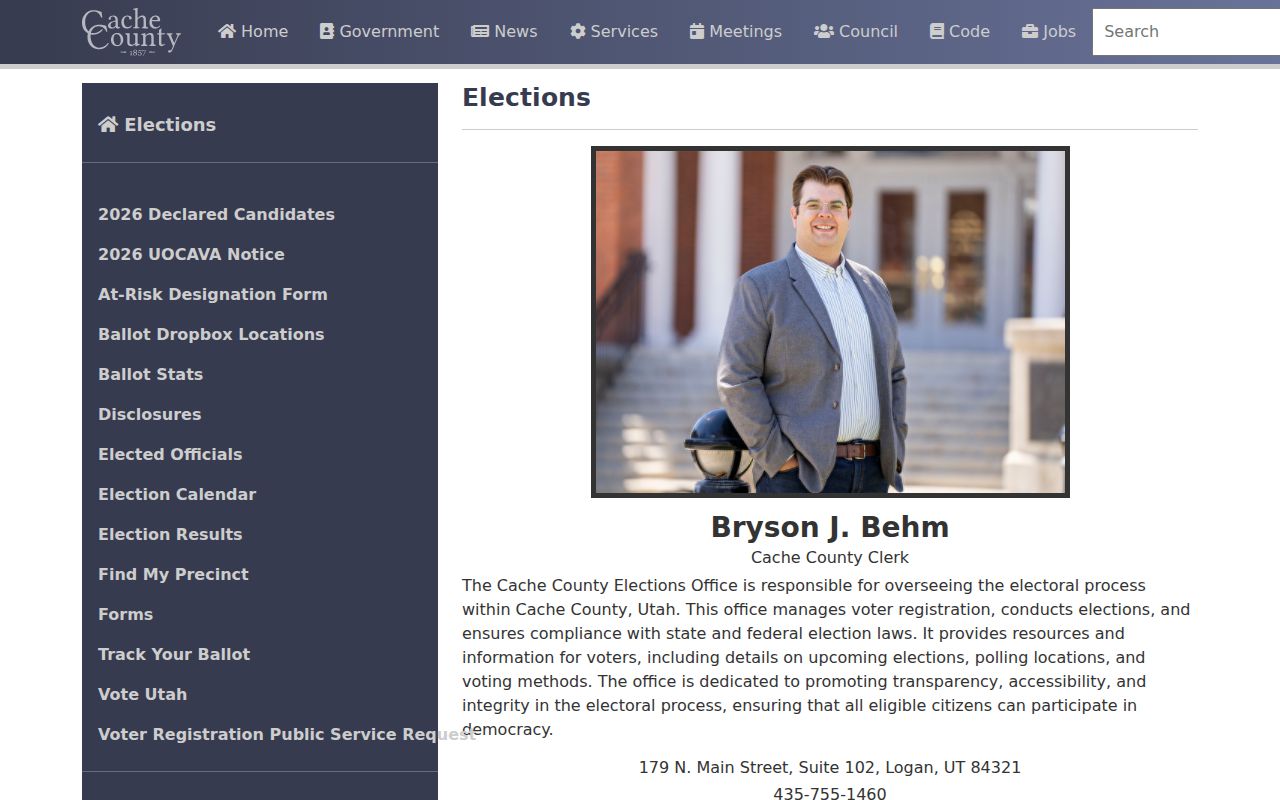
County staff are the right contact when a request needs only Cache County or one of its voting districts.
Note: Ask the county to confirm the current request method, cost, and delivery terms before relying on an older election-data form.
Utah Voter File for Logan
The state voter and election data request page separates four products. The statewide registration database contains Logan records within the full Utah file. The remaining reports address election activity or results. The inspected product summary did not state a narrower buyer category, but current statutory conditions and request terms still govern. Read them before payment because the statewide purchase is one-time, carries no refund, and does not include a subscription or free updates.
| Data product | Scope and timing | Price and delivery |
|---|---|---|
| Statewide registration database | All Utah counties, including Logan records; about 150 MB | $1,050; tab-delimited emailed download, normally within one business day |
| Who Has Voted | Regular even-year primary or general election; daily from 21 days before Election Day through the day before | $35 per election; tab-delimited email delivery |
| Who Has Been Sent an Absentee Ballot | Same stated election and delivery window; not odd-year municipal or post-election | $35 per election; tab-delimited email delivery |
| Precinct-level results | Recent results by precinct | No fee stated on the request page |
A practical state-file request has three stages:
- Select the statewide voter database or the specific election report. Use Cache County Elections instead if only a county or district subset is needed.
- Review the listed fields and restrictions, then proceed to the purchaser contact and payment portion after “Submit Your Request.”
- Save the date and terms with the downloaded file. The state sends an electronic link and does not advertise a certified-paper option.
The official Utah election-data request screen makes the difference between the statewide database and election-specific reports visible.
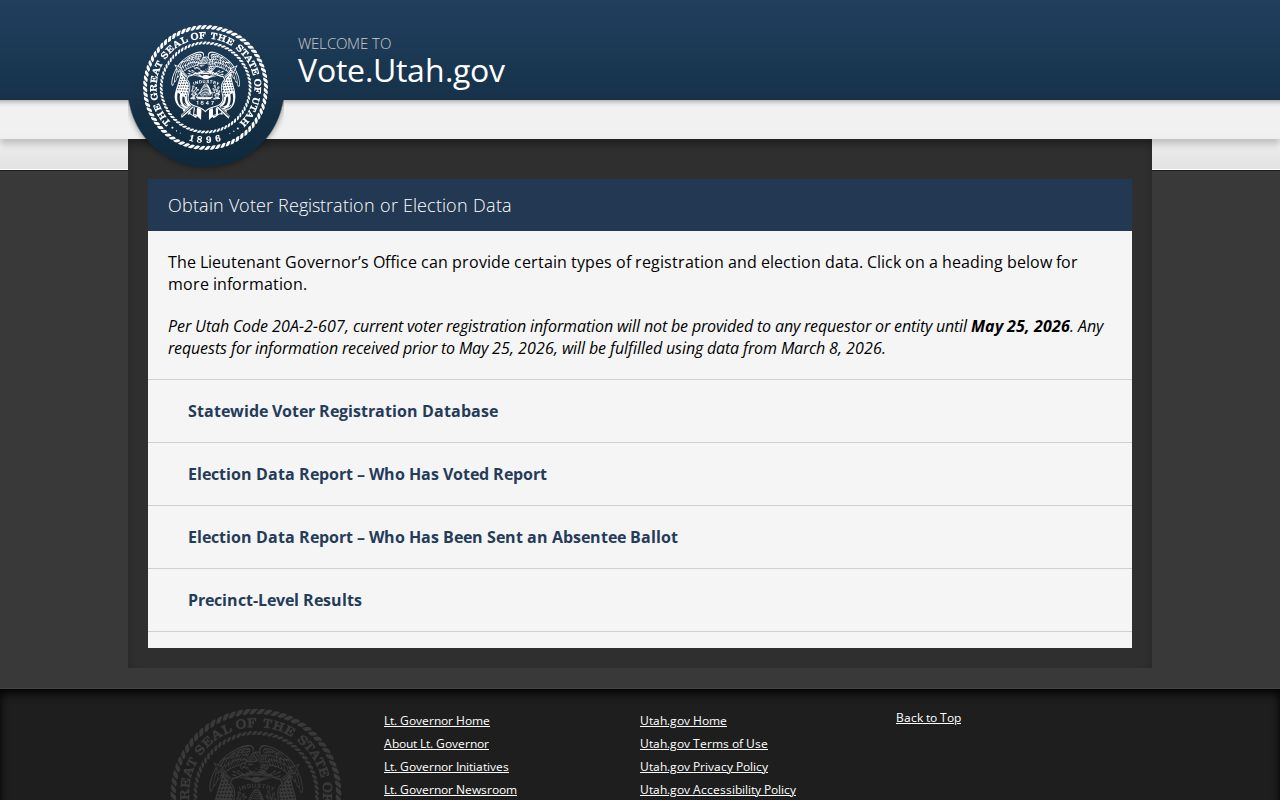
The product choice controls both the data received and the price, so a Logan-only need should be routed to Cache County first.
Logan Vote History Boundaries
Election participation history records whether a voter took part in an election. It never reveals how the person marked a ballot. This boundary applies when reading a Logan voter record in the statewide database and when using a “Who Has Voted” report during its stated release window.
That distinction protects the secret ballot while allowing defined election administration data to be released. It also prevents an easy but serious reading error. Party affiliation and district assignments are registration facts. They do not prove a choice in any race. Likewise, receipt of an absentee ballot does not establish that it was returned or counted.
Use voter data lawfully. Public access does not permit stalking, threats, or harassment. Utah criminal laws may apply based on conduct and intent, while the Election Code governs voter-data access and use. Report suspected misuse to Cache County Clerk or Utah Lieutenant Governor Elections.
Logan Voter Roll Maintenance
Inactive status is not the same as an immediate cancellation. Utah's NVRA data page says a voter who neither participates in a federal election cycle nor registers again is moved to inactive status and sent a confirmation. Continued inactivity through another federal cycle leads to removal for inactivity.
Monthly reports track confirmation cards sent and returned, as well as removals. Utah holds those reports for two years. Removal-reason detail begins with November 2025, while older detail was described as planned. These reports can explain why an older Logan registration no longer looks active, but a status question about one person should still go through the identity-verified lookup or Cache County Elections.
A returned card or a status label reflects list maintenance, not a ballot choice. Dates matter. Save the report month and compare it with the personal status result before drawing a conclusion.
Note: An inactive entry remains a registration status, while removal follows the additional federal-cycle process described by Utah election officials.
Logan Voter File Snapshot
A dated notice under Utah Code §20A-2-607 affected the freshness of voter registration data in 2026. The state request page said current information would not be supplied until May 25, 2026. Requests made before that date were filled from a March 8, 2026 snapshot. The rule should be read as a historical 2026 release condition, not an evergreen waiting period.
This date label matters when comparing a purchased file with a Logan voter's current self-lookup. A person might update a record after the snapshot, yet the older extract would still show the prior data. Record the extraction date, the request date, and any notice delivered with the file. For present work, verify the live terms on the official request page rather than carrying the snapshot rule forward.
Historical Logan Voter Registers
Current portals do not replace historical election sources. Poll lists, registration registers, election abstracts, and returns may connect a name to a precinct and date. For Logan, search the Utah State Archives catalog by Cache County, the county clerk, election terms, and surname. Ask Cache County Clerk about local custody when the catalog does not identify a transferred series.
Do not claim an exact span for Cache County poll books without checking an item-level series description. The available research did not establish those years. That gap makes the access route more important: Archives catalog first, county clerk second, then inspect the register or image tied to the citation. Older records may use initials, former precinct names, or handwriting that resists text search.
Historical voter rolls work as dated residence evidence, not proof that a person stayed at an address. Pair a register entry with a city directory, newspaper, court file, or land record when tracing a Logan family. The county began keeping records in the territorial era, so early identity trails can be split among county, court, church, and territorial series.