
Which Logan Records Are Open
Utah's Government Records Access and Management Act, known as GRAMA, presumes access to public material while allowing agencies to classify other files as private, controlled, or protected. For Logan, the custodian may be a city office, Cache County, Utah Courts, a health department, or a state agency. The label "online" also needs care. A searchable index can be open even when the record image, certified copy, or sensitive fields are not.
| Logan record group | Official keeper | Web access | Copy or fallback route |
|---|---|---|---|
| Deeds, liens, and plats | Cache County Recorder | CORE public parcel index; exact deed-image start is not published | Subscriber images, office copies, or self-directed vault research |
| Parcel and assessment data | Cache Recorder, Assessor, and GIS | CORE and Parcel & Zoning Viewer | Office verification when a legal or certified answer is needed |
| District and justice cases | Utah Courts | Xchange; MyCase for a party's own eligible cases | Court clerk, courthouse terminal, or Archives for transferred files |
| Birth and death certificates | Bear River Health Department and Utah Vital Records | Historical Archives routes after statutory closure periods | Eligible application, ID, fee, or Archives research |
| Marriage records | Cache County Clerk | Application form, not a public name index | Clerk counter or copy request |
| Sheriff reports and custody data | Cache County Sheriff and Utah Corrections | DOC search; county jail list was unavailable at inspection | Phone, email, counter, or notarized remote request |
Some legal limits cannot be cured by visiting in person. Juvenile, adoption, sealed, and expunged court matters are not ordinary name-search sources. Recent vital certificates require a qualifying interest. Utah voter data omits protected identifiers, and at-risk voter records get added safeguards. A missing web result can justify another access channel, but it does not unlock a record that the law closes.
How CORE Opens Logan Property Records
Cache Online Records Express, or CORE, is the main public gateway for Logan parcel and tax data. The free tier permits up to 100 parcel searches a day and returns basic information. Combining fields narrows the result, while starred fields allow partial matching. The tax-year choices seen during research ran from 1999 through 2027, but those choices do not prove that deed images begin in 1999.
| CORE field | Input | Required? | How Logan records accept it |
|---|---|---|---|
| Tax Year | Select | No | Available years load in the form |
| Parcel | Text | No | Example 01-001-0001; partial match |
| Last Name or Business Name | Text | No | Surname or entity; partial match |
| First Name | Text | No | Optional given name; partial match |
| House Number | Text | No | Number is separate from street |
| Street | Text | No | Try directional variants; partial match |
| City | Text | No | Enter Logan when that is the indexed city |
| Legal | Text | No | Legal-description keyword; partial match |
The CORE result can connect a parcel ID with owner name, tax year, property situs, and mailing address. Situs means the physical parcel address; mailing is where tax notices go. Neither proves where the owner lives. Detailed building facts, abstracts, and recorded images belong to the paid tier. CORE calls its data representational, so a formal answer still comes from the office that keeps the source record.
The CORE access page shows the difference between those tiers.
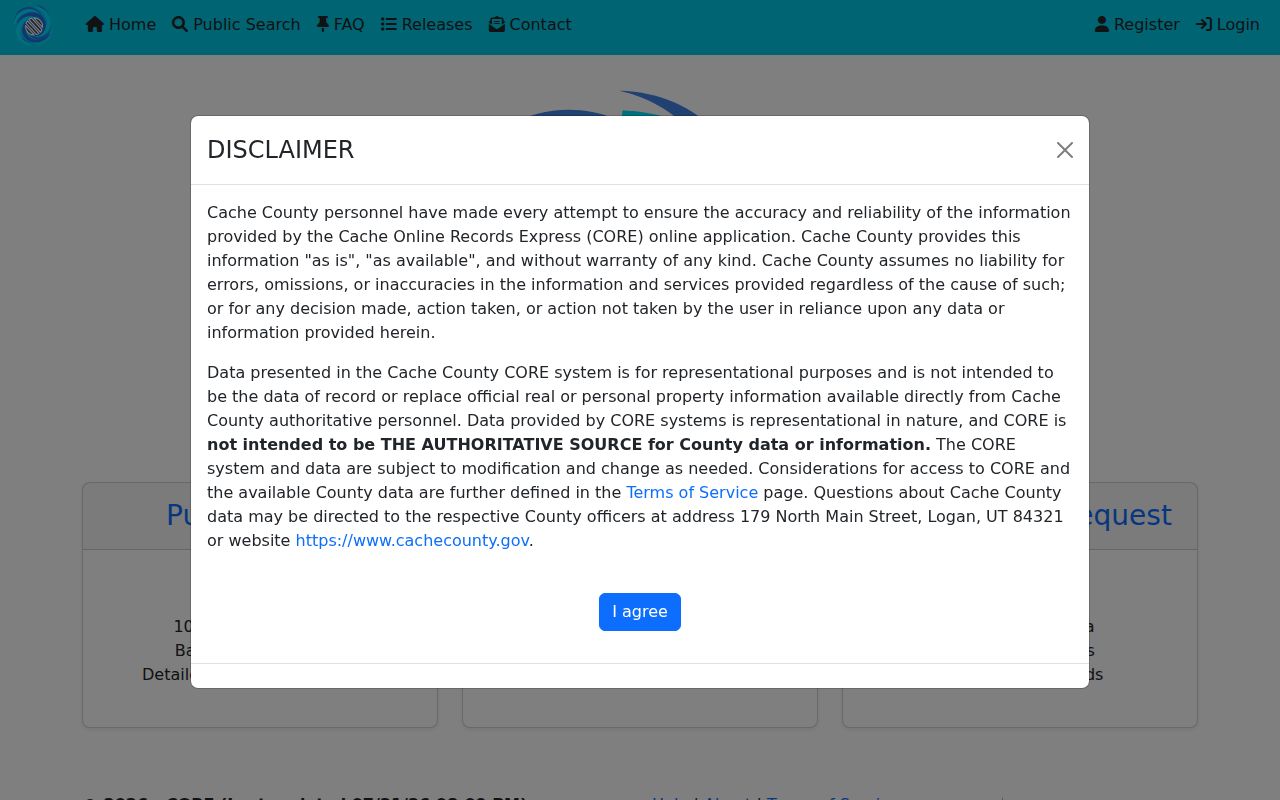
The screen makes clear why a free index result and access to a recorded image are not the same thing.
Insider tip. Use the public tier for a focused parcel check. The advertised $80 monthly tier adds unlimited searches, abstracts, and recorded images.
Logan Recorder Copies and Costs
The Cache County Recorder keeps instruments that affect land title, including deeds, trust deeds, reconveyances, liens, releases, easements, notices, and plats. Its ownership plats show parcel boundaries, current record owner, tax identification number, and acreage. Those files are open for inspection subject to limits on personal identifiers and specially handled instruments. Staff will not perform a title search or find old items that lack a digital index.
Published Recorder copy fees distinguish self-service work from staff help. An unassisted recorded-document copy costs $1 for the first page and $0.25 for each added page. A staff-assisted paper copy is $2 per page, while a staff-assisted emailed copy is $1 per document. An 18-by-18 ownership plat is $8 per sheet, and a 24-by-36 recorded plat is $10. Certification adds $5 plus $2 per page.
- Index
- A finding aid that points to a record; it is not always the full document.
- Recorded image
- A digital picture of the filed instrument, sometimes behind paid access.
- Certified copy
- A copy authenticated by the custodian for an added fee.
- Custodian
- The office that retains and answers for the official file.
- Exemption
- A legal reason that permits or requires an office to withhold all or part of a record.
Note: Checks for Recorder copies are payable to Cache County Recorder, and the office should confirm the total before a large order.
Older Logan Records Need the Vault
Cache County's land trail starts with its 1857 organization, before modern statewide vital registration. Early deeds appear in manuscript books and alphabetical grantor and grantee indexes. Some early instruments may be called "transfers," and survey certificates can share the same books. That language matters when a modern deed term yields nothing.
CORE did not erase the older path. The Recorder says it cannot locate old documents that are not digitally indexed, so the fallback is a self-directed vault search at the office or qualified research help. Utah Archives also holds Cache land surveys, court day books, probate files, and First District registers. The Archives posted browsable Cache court index and register images in 2024, but they are not a surname-search database.
Does no online result mean no record? No. It may signal an older volume, a spelling variant, an archived court file, or a restricted case. Search the right analog index before drawing a conclusion.
Note: A vault can bridge a digitization gap, but it cannot override a statute that makes a record private or protected.
Logan Court Records by Name
Logan's First District Court at 135 N 100 W handles general civil, domestic, criminal, and probate matters. Logan City Justice Court handles local misdemeanors, traffic matters, and small claims. Utah separates online tools by purpose: MyCase is a free, identity-verified account for a person's own eligible cases, while Xchange is the paid statewide public index for district and justice cases.
For First District cases in Logan, the official table reports complete portal data for filings from August 18, 1997. Older cases may appear but can be incomplete. Public district-court images filed from July 1, 2010 may be bought through the service. Xchange searches cost $0.35 and documents $1 after the initial account or guest credit. Most district courthouses and the Utah State Law Library provide free public terminals.
A docket is the dated list of case events, not the whole case file. Search by last name or company, first name, court scope, case type, and date range. A case number is best when known. The service caps results at 500, so add the Logan court location or filing year for a common name. Pleadings, audio, and certified copies come through the court under their own access and fee rules.
Note: Court allegations are not findings, and a charge should be checked against the later disposition before anyone relies on it.
Vital Records Access in Logan
Bear River Health Department is the local route for current birth and death certificates. The Utah Office of Vital Records and Statistics is the statewide office. Cache County Clerk provides marriage licenses and copies, while divorce decrees remain court records. State vital statistics may provide a marriage or divorce abstract for events in its published 1978 through 2010 coverage range.
Utah Code §26B-8-125 opens birth records after 100 years, death records after 50 years, and other vital records after 75 years. Before then, an applicant must show a direct, tangible, and legitimate interest and provide identification. Historical searches move to Utah Archives birth and death resources. Current applications need names, event date and place, relationship, purpose, signature, fees, and proof that links the requester to the person named.
The Clerk's online marriage form collects rich family details, including both spouses' names, addresses, parents' full names, mothers' maiden names, parental birthplaces, and prior-marriage facts. The submitted transaction is not a public name index. The Cache marriage application shows the public-facing form.
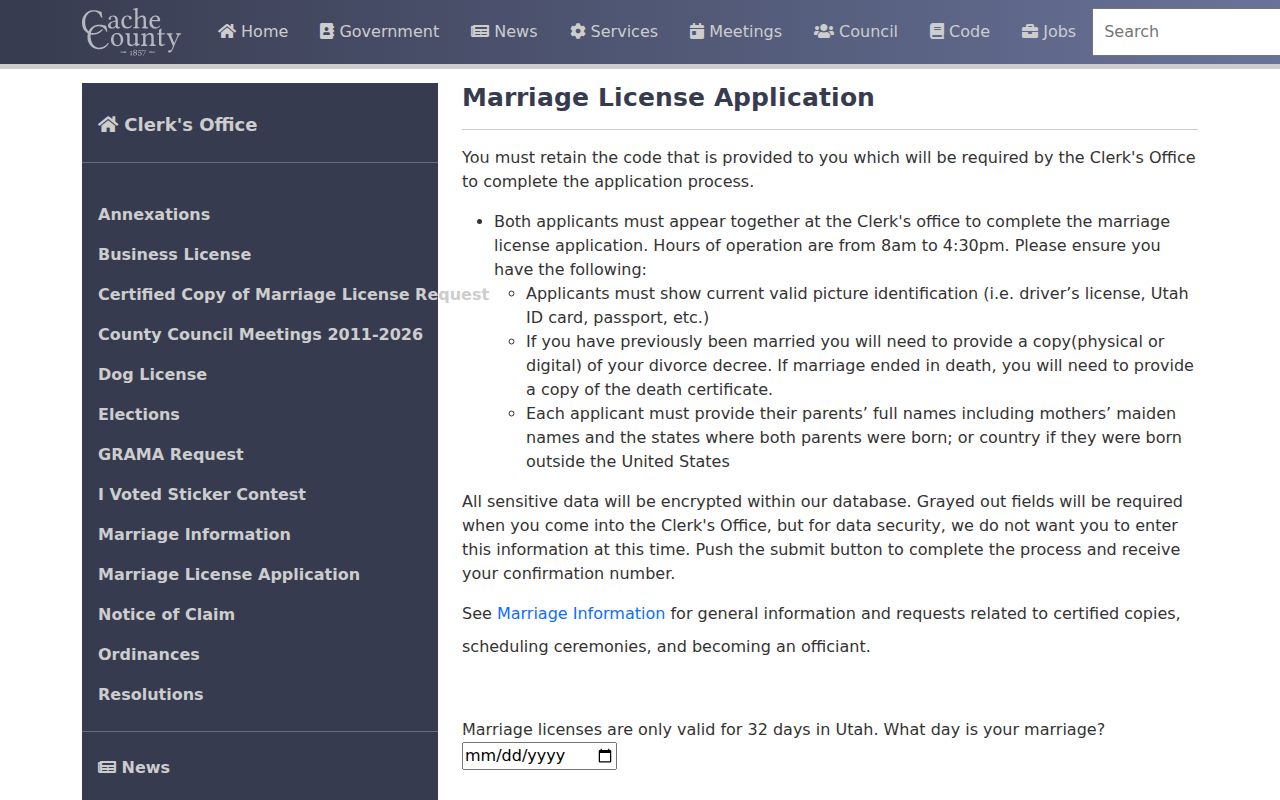
The form is useful for understanding what the office collects, yet it does not turn each sensitive response into an open search field.
Logan Parcel Records and GIS
CORE, ownership plats, and GIS answer different questions. The tax roll ties an owner and mailing address to a parcel. A recorded deed documents a transfer. The Cache Parcel & Zoning Viewer maps parcels, subdivisions, city and county zoning, annexations, and sensitive areas. Its data updates monthly, and ownership or boundary changes after a conveyance can lag by up to 30 days.
A postal Logan address does not always place land inside Logan City. Nearby North Logan, River Heights, Providence, Hyde Park, and unincorporated Cache County can share the local orbit. Check the annexation and jurisdiction layers before choosing a permit or zoning custodian. County GIS also says it stores owner mailing addresses, but not owner phone numbers.
The county's map entry page shows the parcel and zoning tools available for Logan records research.
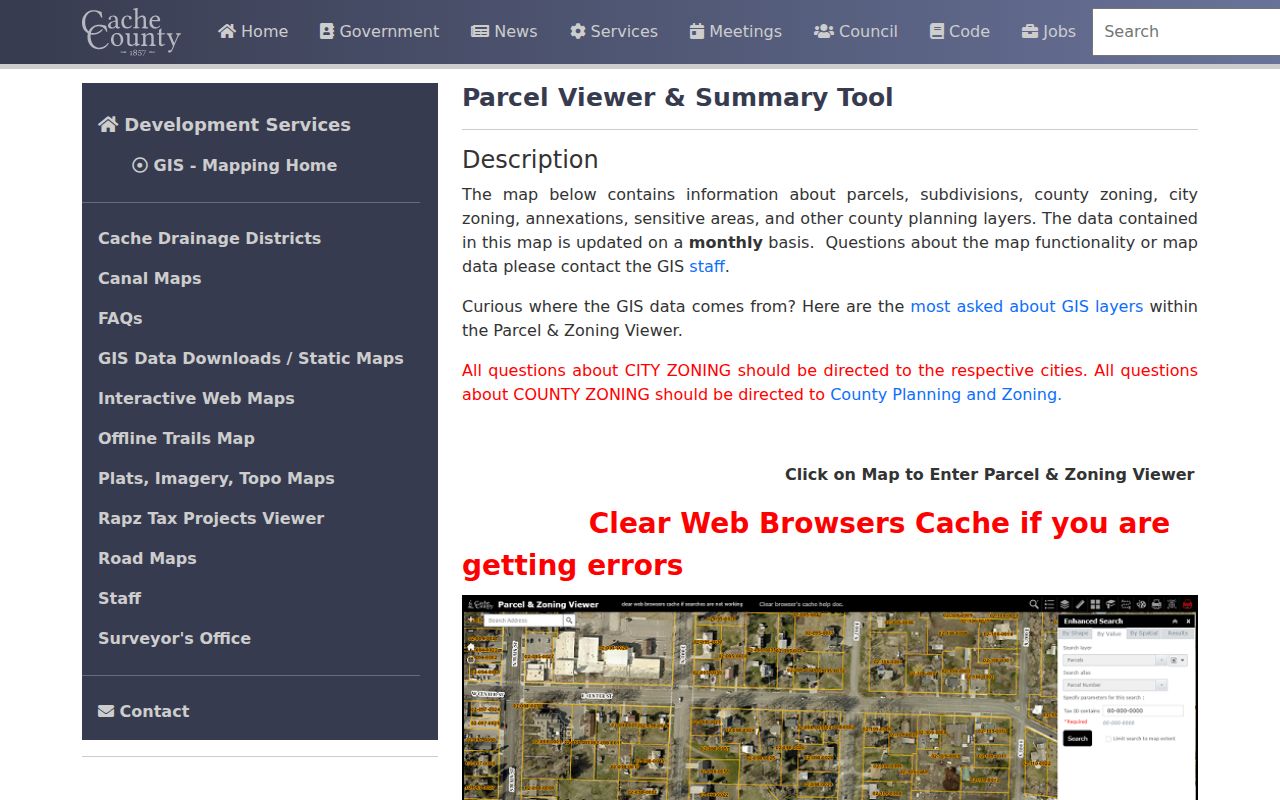
Use the mapped parcel as a bridge to the legal description and Recorder instruments, not as legal proof of a boundary.
Logan Sheriff Record Channels
At inspection, the official Cache County jail page marked its inmate list unavailable and told callers to use 435-755-1227. That is the proper fallback for current booking information. Utah Department of Corrections has a separate offender search for state custody or supervision. Neither source replaces a court docket, and a current charge remains an allegation until the court records a disposition.
Cache Sheriff Records accepts completed requests at recordsrequest@cachesheriff.gov or at 1225 West Valley View in Logan. Remote requesters use the Request for Records and notarization form. Incident and crash reports cost $10 per copy, and normal work can take up to 10 working days. Active reports and private, controlled, or protected material may be withheld. Finished records not collected within 60 days are destroyed without a refund.
Use records lawfully. Open access never permits stalking, threats, intimidation, or harassment. Registry and custody tools carry their own warnings, and Utah law can penalize misuse.
Logan Public Records Office Network
Several Cache offices share the North Main complex, which makes in-person public records work more direct. The Recorder, Clerk, Assessor, and Treasurer have distinct duties even when their data overlaps. Court copies belong at the state courthouse, not with the County Clerk. Call first when a search needs a vault, a certified copy, or a less common record series.
Cache County Recorder
179 N Main, Suite 101
Logan, UT 84321
435-755-1530
Deeds, liens, plats, copies, and vault access
Cache County Clerk
179 N Main, Suite 102
Logan, UT 84321
435-755-1460
Marriage, licenses, elections, and GRAMA intake
First District Court
135 N 100 W
Logan, UT 84321
435-750-1300
District case files, copies, audio, and certification
The Recorder publishes weekday hours of 8:00 a.m. to 5:00 p.m. The county Clerk page supplies direct office contacts for marriage, elections, licenses, and general Cache GRAMA routing. Sheriff records use their own records officer instead of this general route.
Property Watch for Logan Records
Cache Property Watch is a free Recorder alert for someone with a valid interest in a parcel. Signup can begin with a tax ID or an owner, business, or trust name. After the Recorder processes a document tied to the subscribed parcel, the service sends an email. It is an alert after recording, not a title lock, and it does not stop a document from being filed.
The Property Watch signup page presents the county's name and parcel search.
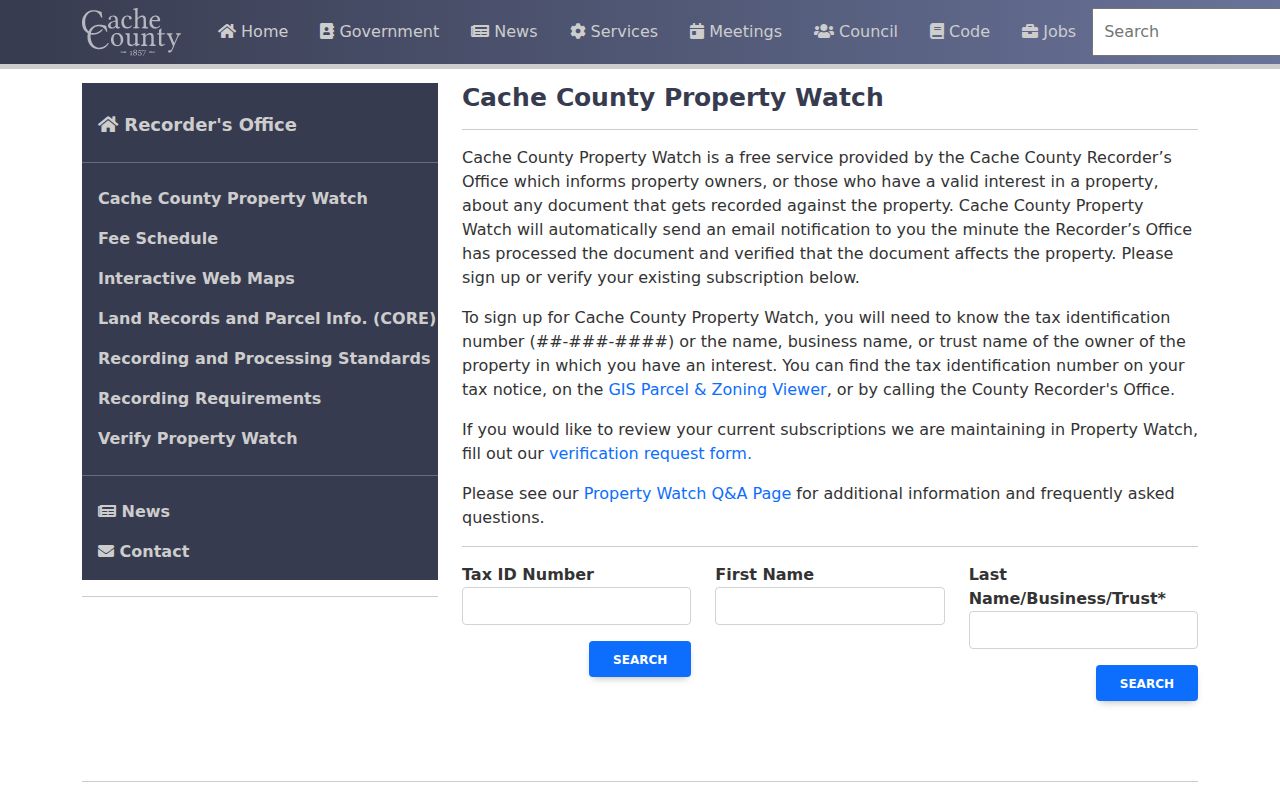
Pair an alert with direct Recorder verification if an email reports an instrument that is not recognized.
Note: Recorder staff can help with Property Watch signup by phone, but the subscriber must still have a valid property interest.
Request Logan Public Records
A good GRAMA request goes to the government entity that actually retains the record. Utah Code §63G-2-204 calls for the requester's name, mailing address, willing email address, daytime phone, and a reasonably specific description. Include the record type, date range, names, and any case, parcel, document, or address identifier. Cache County's general intake runs through the Clerk by portal, mail, or hand delivery.
- Name the custodian. Send deeds to the Recorder, court files to the court, sheriff reports to the Sheriff's Records Officer, and general county records to the Clerk.
- Check existing access. An index or posted file may answer the request faster and at less cost.
- Describe the file narrowly. Give names, dates, subject, and known identifiers. Ask for electronic delivery when it works.
- Ask about cost. Request an estimate and, when supported, a written fee waiver before staff begin substantial work.
- Read the response. The office may grant access, cite a legal denial, refer the request, or invoke an extraordinary circumstance with an estimated date.
GRAMA submission is free. An agency may charge reasonable actual costs for copies, retrieval, and a newly compiled format at no more than the lowest qualified employee's rate. The first 15 staff minutes are free, and classification review cannot be billed. An ordinary decision is due as soon as reasonably possible, normally within 10 business days. A demonstrated public-benefit expedited request has a five-business-day deadline.
Appeal a Logan Records Decision
A denial must state its legal grounds and appeal rights. The first appeal normally goes to the entity's chief administrative officer within the applicable 30-day period. Cache County routes county-record appeals to the County Executive at 199 N Main in Logan or the published GRAMA email. A dispute over a city, court, or state file follows that custodian's route instead.
Utah created the Government Records Office in 2025, replacing the former State Records Committee structure for current guidance. The Utah Archives GRAMA center provides forms, law, and appeal resources. Further review may proceed through the Government Records Office or district court as current Part 4 permits. A narrow revision can also help when an office says a request is too broad or costly.
Keep the original request, proof of delivery, estimates, denial, and each cited law together. That file shows what was sought and preserves the timeline for review.